|
|
Harbor Deepening Project -- Kill Van Kull
Shipping Channel
Purpose and Description of Overall Harbor Deepening Project
FREQUENTLY ASKED QUESTIONS (FAQ’s)
How does the Corps of Engineers get involved in deepening channels?
The U.S. Army Corps of Engineers is the Federal governments lead agency in the development of water resources. In this role, Congress directs the Corps (through
authorization and funding) to study specific water resources problems, such as shipping channels, flood damage risk reduction and coastal storm damage risk reduction.
The Corps will first study the problem by conducting a Feasibility study and then, if it finds that there is a project that will solve the problem, request
authorization and funding to construct that project, in cooperation with a local cost-sharing partner.
Hide
Why is the Army Corps deepening the shipping channels in the Harbor?
The Corps has been involved in deepening channels in the Port of New York and New Jersey for over 100 years. More recently, it completed a feasibility study in 1999
that examined the potential need to deepening the channels to the four main container marine terminals (South Brooklyn Marine Terminal, Global Marine Terminal, the Port
Newark/Elizabeth Marine Terminal and the New York Marine Terminal). This study concluded that deepening the channels to 50 feet below mean low water would provide
safe and efficient passage for the largest container ships then known. In 2000, Congress authorized the Corps to construct the recommended project and in 2005 the Corps
awarded its first of sixteen construction contracts to deepen the channels to 50 feet.
Hide
Why Drilling and underwater blasting is needed and how it will be safely accomplished
Why does the Corps drill and blast the shipping channels?
In order to deepen a shipping channel, material (sand, mud, glacial till, bedrock) must be removed. This process is called
dredging. In some areas of the channels, and in the Kill Van Kill in specific, the channel bottom is bedrock. Since
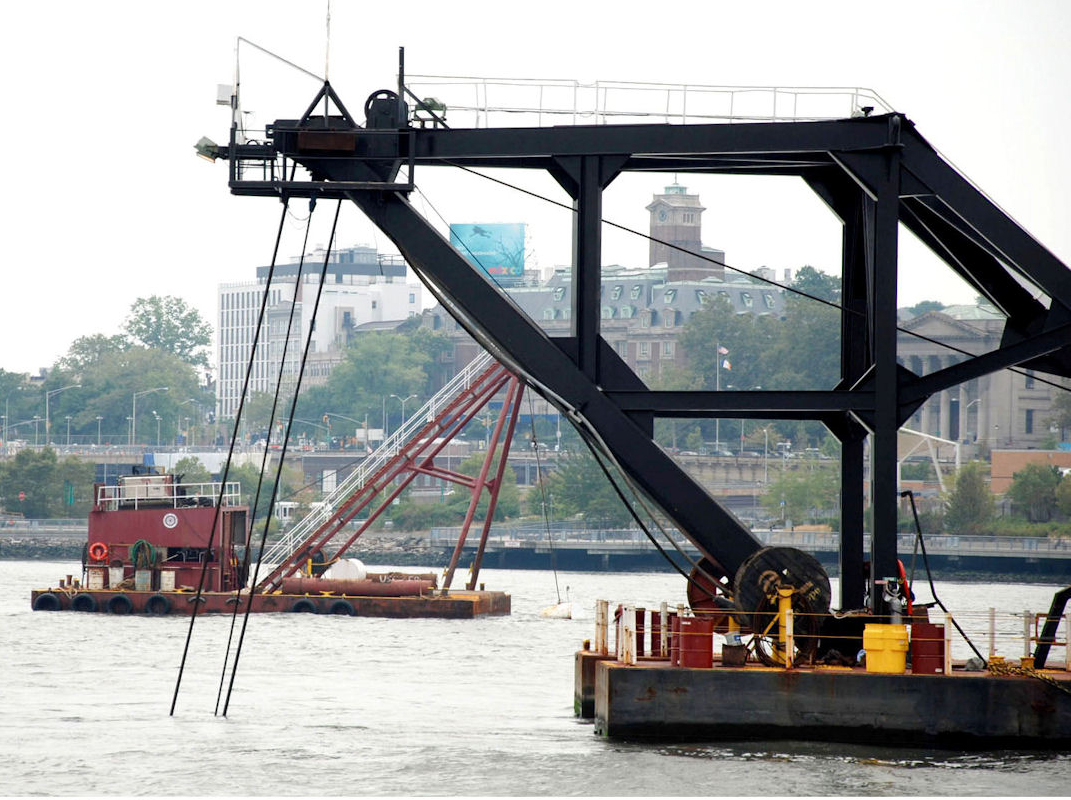
bedrock is hard, an excavator (which looks like a very large backhoe) is first used to remove as much rock as possible.
Once this is done, the rock must be broken up into small pieces in order to be removed. To accomplish this, a series of
small explosions (blasting) are set off which fractures the rock so that the excavator can remove it.
Hide
-
How will I know if the Corps’ contactor will conduct a drilling and blasting operation near my community?
The Army Corps has established several information outlets to keep the public informed on when drilling and blasting will take place.
The first is a requirement for the contractor to conduct a public information session prior to the start of drilling and blasting. For the current contract off of St. George in the Kill Van Kull, two sessions have been held -- One at New Brighton Church in 2008 and a second one at Curtis High School in March 2009.
The second method is to post the blasting schedule on the Corps’s web page. The link to the schedule is www.nan.usace.army/harbor . This schedule will also be provided to the Staten Island Borough Presidents’ office, who will also post it to their web page. Schedules will be posted on a monthly basis.
Army Corps’ web site: index.htm
The third method is to contact the dredging contractor hotline at (201) 339-6470; Army Corps’ Harbor Programs Branch @ (917) 790-8304 or (917) 790-8204 or the Public Affairs Office @ (917) 790-8007.
Contract Drilling and Blasting (CDD LLC) @ (201) 339-6470; (201) 433-9232; (201) 433-9228.
(At print/preparation time of this document, the Army Corps is awaiting approval from the NYC 311 system).
Hide
What is the geographic extent of the drilling and blasting?
The drilling and blasting will take place in the Kill Van Kull, a tidal strait that separates Staten Island from Bayonne, New Jersey, which has been deepened before to create a chipping channel.
Hide
-
Voluntary House Inspection Program
What is a pre-blast inspection and how can I schedule one?
Pre-blast property inspections are conducted free of charge for all property owners and residents who request one. The pre-blast inspection is a process of recording (pictures, video, and or sketches) the existing conditions of a structure to later compare with any structural damage they may have possibly been caused by the vibrations from blasting. The inspections are used to protect the structure owner and the dredging contractor.
Hide
Will I be notified if I should have a pre-blast inspection?
Yes. The subcontractor in charge of the blasting operations has an obligation to notify every structure occupant within a 1,500-foot radius of the blasting activity. He will do this using several methods.
The first notification will be a notice that will be attached to all the doorknobs of residences and businesses. This notice will describe the pre-blast inspection opportunities that are available and how to schedule an appointment. The second method will be the contractor sending a written request to schedule a pre-blast property inspection. This request will be sent to all residents and property owners within a 1,500 foot radius of the blasting activity by first class mail. Finally, a second request for pre-blast property inspections is sent by certified mail to the same property owners and residents to ensure that the information is received. At any time, residents can call the dredging contractor at (201) 339-6470 to schedule an appointment.
Hide
Blasting/Vibration Compliance Monitoring Program, including dedicated HOTLINE phone number(s) for any questions, concerns, or complaints
Won't the vibrations from the drilling and blasting activities damage my property?
There are federal, state and local government agencies that impose restrictions and laws pertaining to ground vibrations and air pressures from underwater blasting. These limits are based on extensive research conducted by many agencies and specialist throughout the world. One of the leading, and most restrictive, is the U.S. Bureau of Mines. The limitation imposed on this deepening project is more restrictive than those the Bureau recommends for occupied residents with regard to property damage. Over the past 30 years, the explosive manufacturing industry has changed dramatically with the development of safer, more reliable products, as well as the high-tech advancements in monitoring equipment.
Many tests have proven that activities in the home have more potential for damage than the blasting that will take place in the project area.
Hide
How will the Army Corps ensure the safety of my property or residence during blasting activities?
To ensure the safety of the communities, residents, and structures in the project area and minimize the level of disturbance the project may cause, the Corps uses the best available drilling and blasting technology, and adheres to all federal, state and local requirements.
The Army Corps and its subcontractors are aware of the concerns that are often associated with drilling and blasting operations in the Port of New York and New Jersey.
To help keep damage from occurring during the drilling and blasting, the Army Corps monitors all blasting activities conducted by its subcontractors to ensure that vibration levels associated with each blast are within the allowable vibration limits that have been set for each project area.
Portable seismographs are used to measure and record the ground vibrations and air overpressure. The specialist conducting this work will analyze the recordings and keep updated information available at all times for the Army Corps, authorized agencies and concerned citizens to review. Blasting event reports are kept for each blast and contain information about the vibration level as it compares to the Table of Safe Blasting Levels established by the explosive industry.
Hide
What should I do if I have a concern once the drilling and blasting operation begins?
Residents or property owners who have concerns during the drilling and blasting activities may call the blasting sub-contractor - Contract Drilling and Blasting (CDD LLC) @ (201) 339-6470; (201) 433-9232; (201) 433-9228.
Resident’s or property owners’ name, telephone number, address, and nature of concern will be documented and reported to the Army Corps within twenty-four hours. Within five calendar days, the subcontractor, along with a Corps Quality Assurance representative, will visit the concerned resident or property owner to inspect the property and discuss specific concerns.
Hide
Independent Noise and Blasting Compliance Monitoring
How does the Corps follow up on concerns and monitor blasting vibrations?
The subcontractor and the Army Corps take concerns about damage claims to any property during blasting operations seriously. Visits to residents and property owners logging concerns include documentation; observing a blast with the resident or property owner at his/her home or place of business; placing strain gauges on any cracks; and/or placing a geophone at the property to monitor vibrations, both of which will remain for the length of the project.
Hide
How will I know if my concern is related to the blasting operation?
Your first step is to either call the dredgers hotline or visit www.nan.usace.army/harbor/
This page will provide you with the latest monitoring report on the basting vibrations. This will provide you will information as to whether a blast occurred on a certain day and its recorded vibrations. Letters acknowledging the date, time, location and what was done during the visit are mailed to the resident or property owner who logged the concern. When the blasting operations have been completed, and the contract is completed, the sub-contractor and a representative of the Army Corps will conduct a final inspection of any alleged concerns.
The subcontractor will send out a final determination letter, which includes the assessment of the damage claim and the course of action, if any, that will be taken. The Corps receives a copy of this letter and will notify property owners or residents in writing of their options should they disagree with the findings.
Hide
For questions regarding the Port of New York and New Jersey Harbor web page, please contact Public Affairs
|
|
Drilling & Blasting Schedule & Information
|
|
Project Fact Sheets
|
|
|
Harbor Navigation Photos
|
|
|
Links
|
|
|
|
|
|